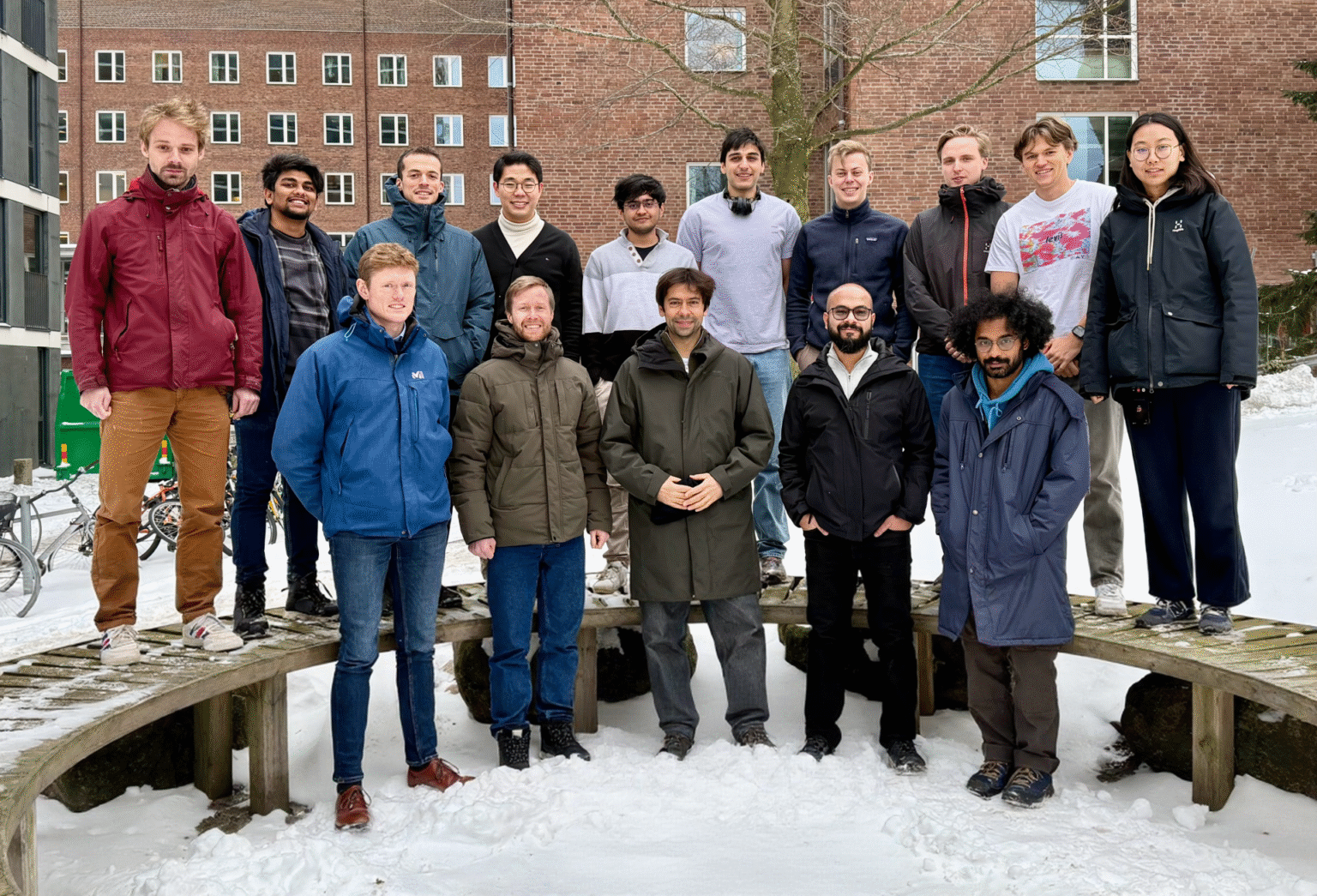
We are the 202Q-lab in Department of Microtechnology and Nanoscience (MC2) at Chalmers University of Technology, in Gothenburg, Sweden. We investigate quantum systems built from superconducting circuits. Our research spans quantum information processing, microwave quantum optics, and quantum thermodynamics, with a common focus on understanding and controlling quantum phenomena in engineered devices.
As part of the Wallenberg Centre for Quantum Technology (WACQT), our group has access to advanced facilities for nanofabrication, millikelvin cryogenics, and microwave measurement. These capabilities allow us to approach questions in quantum physics experimentally, from the design and fabrication of devices to their characterization at the quantum limit.
We welcome students and researchers who are curious about how things work, enjoy solving difficult experimental problems, and want to take scientific responsibility for their work. The level of independence and responsibility grows with your experience: Master’s students learn the foundations of experimental research, PhD students develop and pursue their own research questions, and postdoctoral researchers pursue specific research problems in addition to driving major efforts of the research directions of the group.
If you are interested in joining us, explore the opportunities below and get in contact through the form.
Postdoctoral researchers in our group are given the responsibility to drive one of our major research directions. We also encourage postdocs to develop their own scientific profile through publications, collaborations, and supervision of junior researchers. We are particularly interested in researchers with experience in areas such as superconducting circuits, microwave engineering, quantum optics, low-temperature physics, mesoscopic physics or quantum device fabrication. If you are looking for an environment in which to develop an independent experimental research program in quantum physics, we would be interested in hearing from you.
Fill this form to receive updates on openings in the 202Q-lab.
We are about to have two vacancies opening very soon in two major research directions in the group:
(1) Quantum information processing with bosonic modes
An approach in quantum information processing with superconducting circuits uses bosonic modes in superconducting cavities, also known as continuous-variables quantum information processing. Compared to two-level superconducting qubits, the bosonic architectures can bring advantages such as longer coherence times, well-understood loss channels and resource-efficient quantum error correction due to the their large Hilbert space. Our group has demonstrated the preparation, manipulation, and tomography of a logical qubit encoded in a highly coherent 3D mode and novel non-Gaussian gates in planar architectures. Now we plan to exploit the high dimensionality when investigating novel quantum hardware which uses such non-Gaussian interactions.
Our main effort circles around how we can build trust in bosonic quantum computers when these provide solutions which we cannot efficiently verify with classical computers (which would be the case if one could run Shor’s algorithm, for example). As partners in the consortium of our EU Pathfinder project VeriQuB, our aim is to demonstrate scalable verification protocols for bosonic quantum computers on our superconducting multi-mode platform. Although our group’s initiative is focused on bosonic modes, the designs, workflows, fabrication processes, measurement procedures are closely related to that of traditional qubits, and we benefit greatly from the large ecosystem at Chalmers and within WACQT.
(2) Development of traveling wave parametric amplifiers
A key challenge in scaling superconducting quantum processors is the efficient readout of quantum bits. Current state‑of‑the‑art systems rely on a chain of cryogenic amplifiers: a near‑quantum‑limited parametric amplifier operating at millikelvin temperatures followed by a high‑electron‑mobility transistor (HEMT) amplifier at the 4 K stage of a dilution refrigerator. While this approach provides high‑fidelity readout, it increases complexity, cost, power dissipation, and limits scalability. In the 202Q-lab, we have developed a prototype traveling wave parametric amplifier based on the nonlinear kinetic inductance of superconducting films (KI‑TWPA). Unlike conventional Josephson‑junction‑based parametric amplifiers, this technology can operate efficiently at both millikelvin and 4 K temperatures while providing high gain, wide bandwidth, and excellent power handling.
Our goal is to validate and optimize the KI‑TWPA design, integrate it into superconducting qubit readout setups, and demonstrate high‑fidelity qubit measurements using the amplifier as the only cryogenic amplifier in the system. This would eliminate the need for the conventional HEMT stage, significantly reducing heat load and simplifying cryogenic hardware for large‑scale quantum processors. The project will involve device design and simulation, nanofabrication of superconducting circuits, microwave characterization at cryogenic temperatures, and integration with superconducting qubit experiments. Ultimately, the work aims to validate the technology and develop a minimum viable product for quantum computing applications.
A PhD in our group is centered on developing the ability to formulate and answer research questions independently. Our research covers superconducting quantum systems, microwave quantum optics, quantum information, and quantum thermodynamics.
You will work across the full experimental cycle: from developing an idea and designing a device, through nanofabrication and cryogenic measurement, to data analysis and scientific interpretation. Chalmers and WACQT provide access to the fabrication, cryogenic, and microwave infrastructure needed for this work.
We value researchers who are willing to take ownership of difficult problems and who enjoy working at the boundary between physics, engineering, and experimental technique. During the PhD, you will develop both the technical skills required to build complex quantum experiments and the scientific judgment needed to identify and pursue meaningful research questions.
The aim is not simply to complete a set of experiments, but to develop you into an independent scientist capable of contributing original research to the field.
Fill this form to receive updates on openings in the 202Q-lab.
A Master’s thesis in 202Q-lab is an opportunity to work directly with experimental quantum hardware. Rather than studying quantum systems only through models and simulations, you will learn how such systems are designed, fabricated, measured, and understood in the laboratory.
Depending on the project, your work may involve superconducting circuits, microwave measurements, cryogenic experiments, device simulation, or nanofabrication. You will work closely with researchers in the group and take responsibility for a defined research project that contributes to our ongoing work in quantum information, quantum optics, or quantum thermodynamics.
A thesis in the group is well suited to students who want experimental experience and are considering further research in quantum physics or a career in quantum technology.
Fill this form to receive updates on openings in the 202Q-lab.
Research internships provide an opportunity to experience experimental quantum physics before committing to a longer research project.
Depending on your background and the needs of the laboratory, an internship may involve circuit simulation, CAD and device design, microwave instrumentation, data analysis, nanofabrication, or cryogenic measurements. You will work alongside PhD students and postdoctoral researchers and gain an understanding of how experimental research is actually carried out from an initial design through measurement and analysis.
We welcome students who are curious, technically minded, and willing to learn. An internship is also a good opportunity to find out whether experimental quantum research is something you would like to pursue further, for example through a Master’s thesis or PhD.
Fill this form to receive updates on openings in the 202Q-lab.
Across all career stages, we value curiosity, rigor, independence, and persistence. Experimental research rarely proceeds exactly as planned, and progress often depends on being willing to understand why something did not work, modify the approach, and try again.
You do not need to arrive knowing everything. We expect people joining the group to learn. What matters most is a willingness to engage seriously with difficult scientific and technical problems, to work constructively with others, and to take increasing responsibility for your research.
If that sounds like the kind of environment in which you would like to work, we encourage you to get in touch.